
Winter Returns To Europe
Winter has wasted little time returning to Europe’s mountains. In just 48 hours, bare Alpine slopes have turned white under fresh early-October snow.
The snowfall swept into the western Alps on Thursday, Oct 8, as colder air pushed south, bringing snow to the French and Swiss Alps before spreading east.
Up to 40 cm (16 inches) accumulated on the glacier at Les 2 Alpes, with the snowline dropping to 1,500 m (4,900 ft) in parts of the northwestern Alps. Further flurries are expected Friday and Saturday.
Fresh snowfall also reached the Pyrenees on Thursday, with white slopes at La Mongie in France’s Hautes-Pyrénées.
After a summer of relentless heat warnings, winter is already returning to Europe’s mountains.
Snowstorm Chaos In Russia’s Far East
Winter has hit Russia’s Far East hard, with heavy snows bringing traffic to a standstill across parts of the Magadan region.
On Thursday, a powerful storm swept the region, dropping heavy, wet snow.
The likes of Olskiy Pass have been hit hard, with extensive travel disruptions reported on the Solnechny–Ola highway. Heavy trucks lost traction, while buses bound for Ola and Klepka were unable to complete their journeys, leaving passengers stranded.
Snowplows were deployed as authorities urged motorists to avoid travel.
The snow extended inland, where temperatures were already well below freezing. By Friday, lows of -19C (-2F) at Yagodnoye, -16C (3F) at Susuman and -11C (12F) at Omsukchan were posted, with further blowing snow expected.
Heavy snow warnings also cover multiple inland districts.
Forecasters warn of another sharp cooldown over the weekend and additional snows next week.
SMB Data Is Back—Sort Of
Greenland’s surface mass balance (SMB) data is finally returning after weeks of missing updates, with the Danish Meteorological Institute (DMI) confirming that its model is running again.
A notice on DMI’s Polar Portal reads: “Issue with the SMB model solved. The model is running, but it will take a little time. Thanks for your patience.”
The daily charts, which stopped updating in early September, have now advanced to at least September 22, with further backfilling expected as the system catches up. The accumulated charts are further behind still.

The returning data should soon provide a picture of how the 2026–27 season is developing.
DMI has offered no detailed explanation for the interruption or a firm date for full restoration.
How El Niño Works
There’s been much talk of El Niño lately, so here’s the simple explanation of what it actually is.
Normally, strong trade winds blow across the tropical Pacific from east to west.
Those winds shove warm surface water toward Indonesia and Australia, allowing colder water to rise from the deep near South America.
Over time, a huge reservoir of warm water builds across the western and subsurface Pacific.
Then the trade winds weaken.
The warm water begins sloshing back eastward across the equator. Cold-water upwelling near South America is suppressed, and a much larger area of the Pacific surface becomes unusually warm.
That is El Niño.

El Niño doesn’t create this ocean heat from nowhere; it redistributes heat already stored within the tropical Pacific, bringing more of it toward the surface and atmosphere. This is why global air temperatures jump during strong El Niño events.
But bringing more heat to the surface also makes it easier for that energy to escape to space as infrared radiation. In that sense, El Niño can act like a release valve: stored ocean heat is brought up, transferred to the atmosphere and ultimately radiated away.
Strong events can substantially drain the tropical Pacific’s upper-ocean heat reservoir.
Eventually the trade winds strengthen again, cold-water upwelling returns in the eastern Pacific and the system can swing hard toward La Niña, cooling the surface while the tropical Pacific begins reorganizing and rebuilding its heat reservoir.
El Niño, therefore, is not simply an engine of warming.
It is not a climate system malfunction.
It is part of a natural ocean-atmosphere cycle that stores, moves and releases heat—venting much of it into space.
The Dirty Side Of ‘Clean’ Energy
The minerals powering the West’s supposedly “clean energy” future are leaving a toxic legacy in parts of Africa—with poisoned waterways, contaminated farmland and mounting allegations of human rights abuse.
In February 2025, a tailings dam at Chinese-owned Sino-Metals Leach in Zambia collapsed, releasing an estimated 50 million liters (13.2 million gallons) of highly acidic copper-processing waste into waterways feeding the Kafue River—a vital water source for millions.
The waste was extremely corrosive, with Zambia’s parliament reporting a pH below 1.
A subsequent government-commissioned assessment identified dangerous contamination in wells, soils and crops, even recommending the relocation of residents from Kalusale.
Residents have since taken legal action.
And Zambia is no isolated case. According to the Business and Human Rights Centre, allegations of abuse linked to transition-mineral mining across Africa more than doubled in a single year, from 45 in 2024 to 100 in 2025.
These are the mining operations supplying copper, cobalt and other materials for electric vehicles, batteries and renewable energy infrastructure—technologies marketed to Western consumers as “clean.”
Yet the environmental damage is proving immense.
And this points to a wider problem with today’s environmental priorities: pollution needs separating from CO₂.
A 2021 study estimated that 89% of the plastic entering the world’s oceans via rivers originates in Asia (81%) and Africa (8%).
This is real, measurable environmental destruction—poisoned waterways, contaminated land and plastic entering the oceans.
Yet Western politics remains fixated on domestic CO₂ cuts while China’s vast emissions, Asia and Africa’s plastic pollution, and the toxic mining practices supplying the wind and solar industries escape anything like the same political pressure.
Alarmists preach environmental responsibility at home while ignoring the damage being done abroad—much of it in the name of their own “green” agenda.
Three Earth-Bound Solar Eruptions
Earth faces up to three CMEs between October 9 and 11, with G3 (Strong) storm levels possible.
The eruptions followed powerful M-class solar flares, including an M6.7 event on October 8:
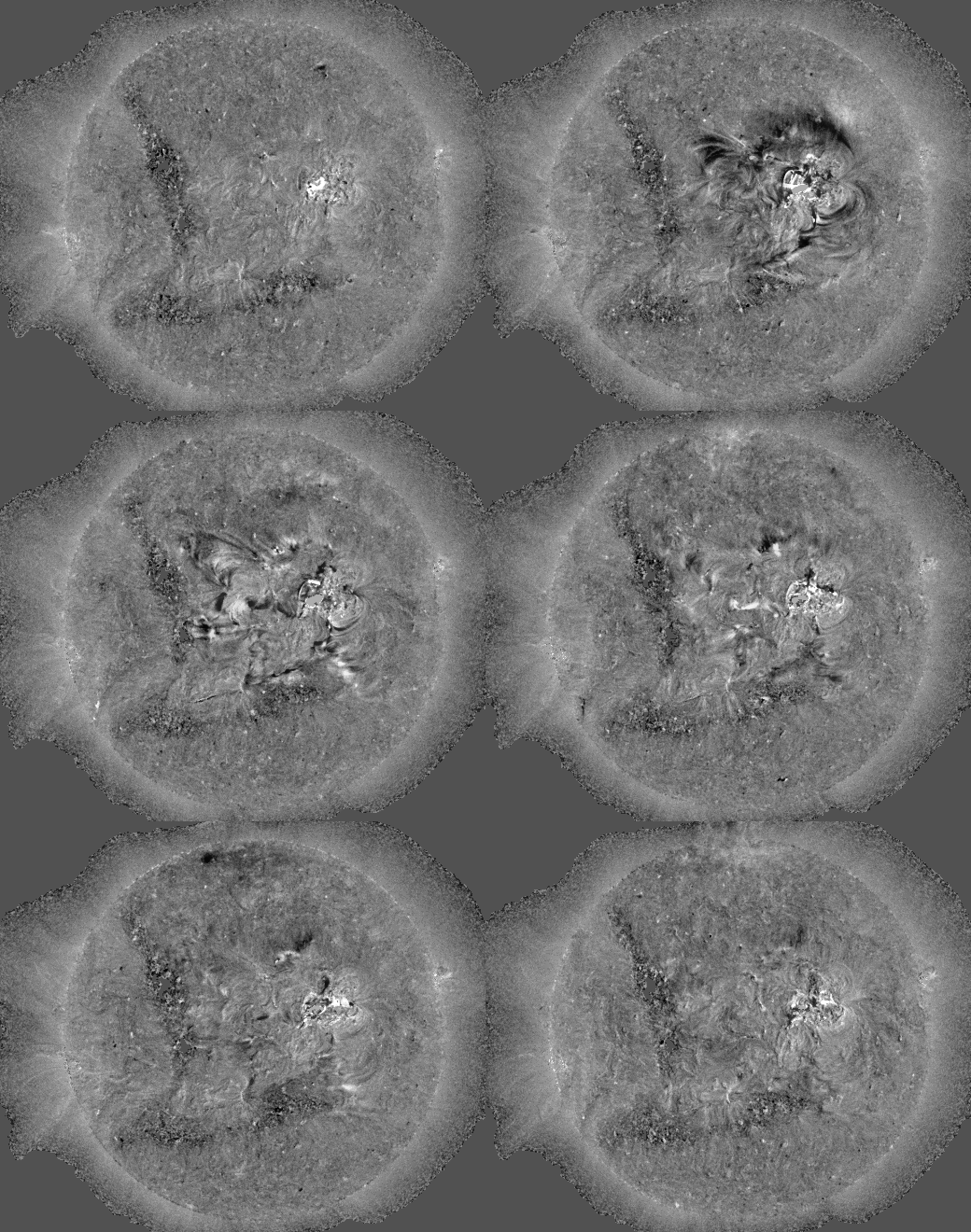
Of particular interest is the possibility of the CMEs merging before reaching Earth.
NASA estimates one eruption was traveling at 310 km/s, compared with 723 km/s for a later eruption.
The faster CME could overtake the slower one, compressing their magnetic fields into a combined front—a cannibal CME.
Such mergers can strengthen or prolong geomagnetic storms, as seen during the powerful May 2024 event.
Widespread auroras are possible this weekend, with the near-new Moon providing dark skies.
Thank you for your continued support.
Enjoy your weekend.
I’ll be back Monday, as always.
Best,
Cap


Notable that despite El Nino there has been a downtick in the UAH temperature calculation this month, and while there has been a steady riseing trend since 1979, 0.16 degrees per DECADE is hardly the stuff of global ‘boiling’.
Yes the term, clean energy, is definitely an oxymoron. I love your site, Cap. I find your explanations of a complex subject to be well researched and informative. Thank you for all you do!
If that solar eruption video clip is an “animation,” me thinks they overdid it!
The biggest BS in history again about this Isaias tropical system. It weakened very rapidly right after landfall in Destin, FL after making landfall as a minimal hurricane. I noticed the strongest winds according to the NWS in Mobile, AL was 74/G105mph near the islands of North FL – indicating a minimal cat 1.
6 hours later it had almost disappeared into a sub-tropical depression after becoming post-tropical. This must be a new record as to dissipation rate of a tropical cyclone!
But they never tell you that part in the drive-by media. (Of course)
What a total wimp and ludicrous hype!! LOL.
I’m in East TN here and we had nothing out of this – maybe a few gusts to 30mph this morning with little rainfall. The winds have diminished completely by afternoon. Since the remains are located in Central AL right now, most cat 1’s at landfall 18 hours ago should be at least 50mph over land at this time, (17 hrs later) with heavy rains and strong gusty winds far to the East and North.
This system totally poofed out. I’ve never seen a hurricane dissipate this fast!!
Also this season as a whole is the most inactive since 1914 with not a single hurricane between June and September 2026. 37years+ with not a single major for Charleston and also 30 years with no majors hitting the East coast since Fran of 1996. They’re not as frequent as they used to be.
Ken
I live in N Alabama, directly in the path after landfall. I had consistent moderate wind from the east for a few hours and rain for much of the day but nothing you’d notice as a tropical system. After landfall, it downgraded immediately to a depression.
The climate people were hysterical for a hurricane to hype. This was it, even though it was thankfully a small event.
I had my devices charged just in case. One is a large storage battery with various plug ports capable of powering a coffee pot, a plug in lamp, a radio and laptop/phone for half a day or more. I have never had to use it.